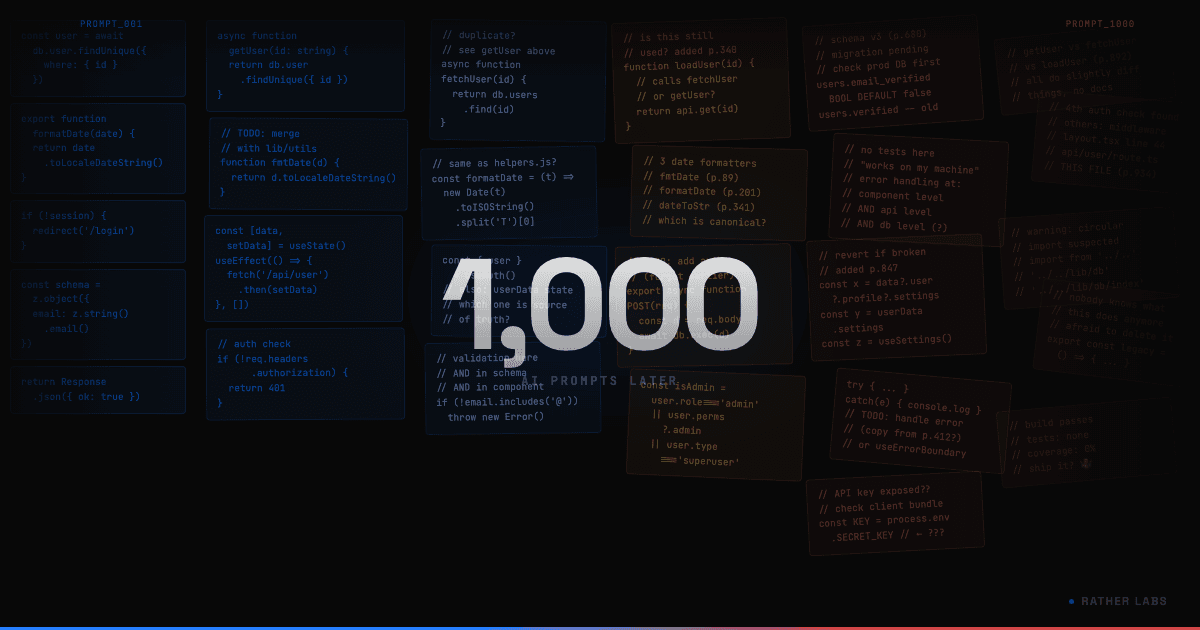
What Happens to Your Codebase After 1,000 AI Prompts
The first 10 prompts feel like magic. By prompt 1,000, you've built something real... and quietly accumulated something you didn't plan for. Here's what actually happens to a codebase when AI tools do most of the writing.

TL;DR
AI coding tools produce coherent code for roughly the first 100 prompts, but as a project grows the codebase accumulates architectural drift, scattered business logic, missing tests, and security gaps the AI can't see. What you've built is a validated concept, not a production foundation — the fix is an engineer-led assessment of what to keep, refactor, or rebuild, not more prompting.
The first 10 prompts feel like magic. You describe a feature, the AI builds it, and it works. By prompt 200, you're iterating on real feedback from real users. By prompt 500, something feels different. You're spending more time explaining the existing code to the AI before asking it to change anything. By prompt 1,000, you've built something real and quietly accumulated something you didn't plan for.
The first 100 prompts: everything works
When you start with Lovable, Bolt, or Cursor, the AI is working with a clean slate. No history, no contradictions, no prior decisions to forget. You describe what you want and it generates coherent code because there's nothing else to contradict.
At this stage, the AI does well. It makes sensible choices, connects the frontend to the backend, sets up authentication and database schemas in patterns that fit together. If you're a non-technical founder, it feels like having a senior engineer at your disposal. If you're a developer, it feels like moving at 3x speed.
The output isn't perfect, but it's consistent. One thing is in charge and it has a clear picture of the whole system.
Prompts 100–400: the drift begins
Around prompt 100, the codebase starts to have history. Decisions made in early sessions are invisible to later ones. The AI's context window has limits, and as the project grows, it can no longer hold the entire codebase in mind when writing new code.
This is where drift starts.
The AI builds a new feature using a slightly different pattern than the one it established 200 prompts ago. Not wrong, exactly. It works. But now there are two ways to do the same thing in the same codebase. You have one utility function for formatting dates in /lib/utils.js and another in /components/helpers.js because the AI forgot it had already written the first one.
You also start to notice something the developer community calls architectural drift: the code begins to contradict itself. State management is handled one way in older features and a different way in newer ones. API calls use different error handling patterns depending on when they were written. The AI isn't being inconsistent on purpose. It's just working from incomplete memory each time.
The app still works. The drift is invisible to users. But it's accumulating.
Prompts 400–700: the fix-one-break-ten cycle
This is the phase that breaks founders' confidence. You ask the AI to fix a bug and it fixes it, but something else stops working. You ask it to add a feature and it adds it, but quietly changes something in a file it didn't realize was connected.
This happens because the AI is writing code in a system it can only partially see. It makes a change that's locally correct — the specific function behaves as asked — but misses the downstream effects.
The result is the fix-one-break-ten cycle: each prompt fixes something and introduces something else. You start spending more time debugging the AI's fixes than you spent on the original problem. The speed advantage that felt so dramatic at the start starts to erode.
There's also a subtler problem: the AI stops being able to reliably find things. When you ask it to "update the authentication logic," it might update one authentication check and miss two others, because that logic has spread across multiple files over 600 prompts and no single file contains it all.
Prompts 700–1,000: the things you can't see
By the time you've run a thousand prompts, the visible problems are the small ones. The serious ones are the ones you haven't noticed yet.
Security gaps appear at the seams. AI tools are good at writing functional code and poor at writing secure code. Not because they don't know security concepts — they do. But they don't think adversarially. They write code that works for normal inputs and honest users. They don't ask: what if someone sends a crafted request? What if someone reads the client-side code and finds an exposed API key? What if there's no validation on this endpoint because the AI assumed it would only be called from the frontend?
A scan of over 1,600 apps built on Lovable found that more than 170 had security vulnerabilities exposing user data to anyone who knew where to look. Those weren't edge cases. They were the standard output of an AI focused on functionality, not on who might misuse it.
Business logic leaks into the wrong layers. In a well-architected application, the rules that govern your product — who can see what, what actions trigger what outcomes, how data gets validated — live in one place. In an AI-built codebase after a thousand prompts, those rules tend to be scattered. Some in the database, some in the API layer, some inside React components because the AI put them there while building the UI and it seemed fine at the time. When you need to change a rule, you have to find every place it lives. That's hard, because there's no documentation and the AI that wrote it is stateless.
The database schema has grown in the wrong direction. Early schema decisions compound. If the AI set up your user table one way at prompt 10 and you've been building on top of that for 990 prompts, the accumulated weight is real. Adding a feature that needs a different data model is no longer a quick task. It's a migration with downstream effects on dozens of queries.
There are no tests. Unless you explicitly ask for them, AI tools don't write tests. They write code that passes the happy path — the scenario where everything goes right. Edge cases, error states, unexpected inputs go untested. In a production app with real users, the happy path is a minority of what actually happens.
What to do about it
None of this means vibe coding was a mistake. It probably wasn't. The prototype you built validated an idea that might have taken months and real capital to test the traditional way. You have users, feedback, and proof that something is worth building.
What it means is that the thing you built with AI is a validated concept, not a production foundation. The next step isn't to keep prompting. It's to understand what you have and make deliberate decisions about what to do next.
That starts with an honest technical assessment: what can be kept, what should be refactored, what needs to be rebuilt. The answers depend on the specific codebase, the business requirements, and where the product is going. It has to be done by engineers who can read the code and understand the system, not by asking the AI to review itself.
In our work on these projects, the same patterns show up every time: scattered business logic, inconsistent patterns, missing auth checks, a schema that made sense at prompt 10 and creates friction by prompt 1,000. We've also seen the other side — codebases where the AI made good structural decisions and the path to production is shorter than expected.
You don't know which one you have until you look.
If you've built your MVP with Lovable, Bolt, v0, or Cursor and you're starting to feel the weight of those 1,000 prompts, that's the right moment to get an outside perspective. Not to throw away what you built, but to understand it clearly enough to know what comes next.
Rather Labs works with founders who've validated their ideas and are ready to build the real thing. If you have an AI-built MVP and want an honest technical assessment, see how the Codebase Diagnostic works.
Frequently asked questions
Is AI-generated code safe to use in production?
Not as-is. AI tools write code that works for the happy path and honest users, but rarely think adversarially. A scan of 1,600+ apps built on Lovable found more than 170 exposing user data. Before production, AI-built code needs a security and architecture review by engineers who can read the whole system.
Why does my AI-built app start breaking more as it grows?
Because the AI writes each change from incomplete memory of the whole system. Past a few hundred prompts this causes 'architectural drift' and a fix-one-break-ten cycle: each change is locally correct but misses downstream effects spread across files the AI can no longer hold in context.
Should I rebuild my AI-built MVP from scratch?
Usually not. The MVP already validated your idea, which is the expensive part. The right next step is an honest technical assessment of what can be kept, refactored, or rebuilt. Some AI-built codebases have a shorter path to production than expected — you don't know which one you have until engineers read the code.
Get posts like this in your inbox