Fractional CTO vs. CTO-as-a-Service vs. Full-Time CTO: Which One Do You Actually Need?
Three options that sound interchangeable, structured very differently. The real question isn't the price tag: it's whether you need advice, delivery, or both, and what happens when you buy the wrong one.

TL;DR
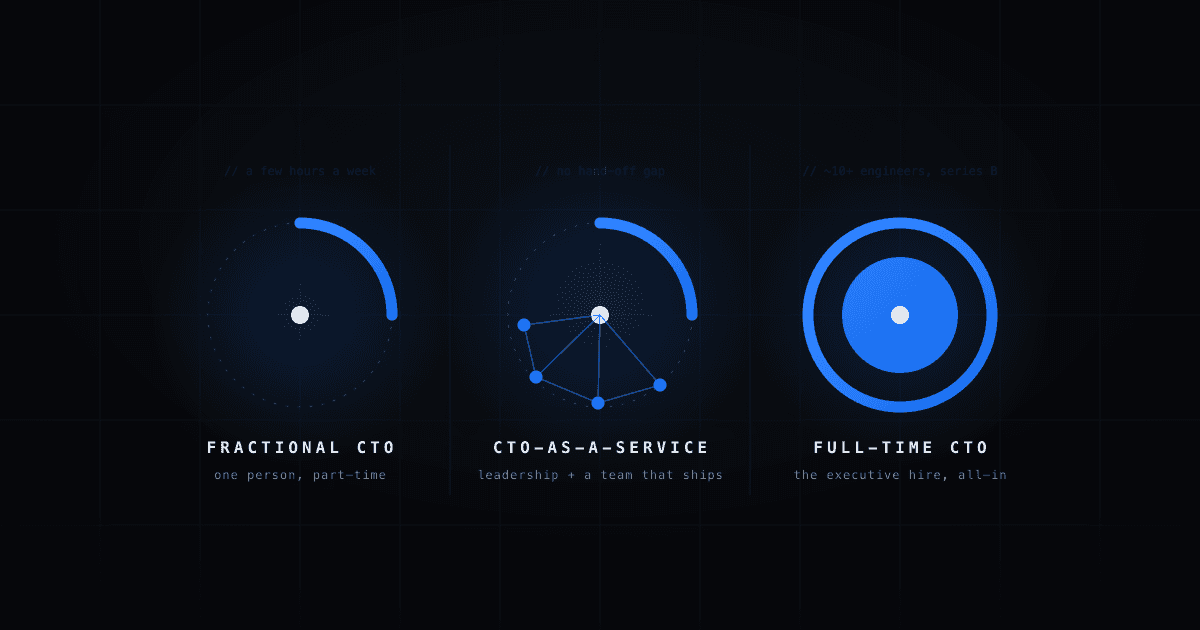
A fractional CTO is a senior technical leader working part-time: right when you need strategy, limited because one person can advise but not build. CTO-as-a-Service puts a delivery team behind that same leader, so you go from advisory to execution without hiring a separate dev shop. A full-time CTO makes sense at roughly 10+ engineers, when proprietary tech is the differentiator, or at Series B.
At some point, every non-technical founder hits the same wall. Plenty of technical ones do too. The company needs real technical leadership, and a $300k+ executive is neither affordable nor obviously necessary.
Google that problem and you get three answers that sound interchangeable: fractional CTO, CTO-as-a-Service, and biting the bullet on a full-time hire. They are not interchangeable. They put different people in the room, and they fail in different ways. The price tag turns out to be the least interesting difference between them.
Here is how the three models actually compare, and a way to decide that starts from your stage instead of your budget.
The Three Models at a Glance
| Fractional CTO | CTO-as-a-Service | Full-Time CTO | |
|---|---|---|---|
| What it is | A senior individual, part-time | A fractional CTO backed by a delivery team | An executive employee |
| Typical cost | $5k–$15k/month | Retainer + team scales with scope | ~$320k/yr avg + benefits |
| Equity | Usually none | None | ~1% (non-founder, Series A/B) |
| Can they build? | Advises; you build elsewhere | Yes, same firm, same leadership | Hires and manages your team |
| Continuity risk | One person's calendar | Firm-level: leadership + team persist | Retention of one key hire |
| Best stage | Pre-seed → seed, advisory needs | Idea → Series A, leadership and delivery | ~10+ engineers, Series B+ |
Numbers out of the way. Now the part that matters: what each model is actually for, and where it breaks.
Fractional CTO: Senior Judgment, Part-Time
A fractional CTO is a senior technical leader, usually someone who has run engineering before, working with your company a few hours a week on a monthly retainer.
For the right problem, the value is real. Architecture decisions made by someone who has made them before. A technical roadmap that survives contact with investors. Someone senior in the room when you evaluate a dev shop's proposal, or a candidate's claims about what they can do.
Where it breaks: a fractional CTO is one person, and one person can advise but cannot build. The moment strategy turns into "now we ship this," you are assembling executors from somewhere else: freelancers, an agency, your first hires. Your fractional CTO becomes a part-time manager of people they didn't choose, accountable for none of what gets delivered. That seam between the person who decides and the people who build is where early-stage products quietly go wrong.
The second failure mode is simpler. You are one line on a busy person's calendar, and the bus factor is exactly one.
CTO-as-a-Service: Leadership With a Team Attached
Fair warning before this section: this is the model we sell at Rather Labs, so read it knowing that. At the end you'll find the test we think you should apply to anyone offering it, us included.
CTO-as-a-Service starts from the same place as a fractional CTO. A senior technical lead owns your architecture, roadmap, build-vs-buy decisions, and engineering standards. The difference is that the lead comes from a firm, with an engineering team behind them. That changes three things.
Strategy and execution stop being separate purchases. When the roadmap says build, the same person who set the direction brings in a team that ships it. No hand-off gap. No re-explaining context to a dev shop that wasn't in the room when the decisions were made.
Accountability shifts from advice to outcome. A solo advisor is accountable for the quality of their recommendations. A firm that both decides and builds is accountable for whether the thing works in production. Those are very different conversations when something breaks.
Continuity is institutional, not personal. If one engineer rotates out, the leadership, the context, and the standards stay.
Where it breaks: if all you need is a few hours of senior judgment a month, with no building on the horizon, a solo fractional CTO is leaner and probably cheaper. At the other end: if you already have the technical leader, you don't need someone else's. What you need is senior execution under your CTO's direction, which is a different purchase (engineers embedded in your own team, or a dedicated engineering team for a whole workstream) and shouldn't be dressed up as leadership you didn't ask for.
One more thing CTO-as-a-Service is not: a rebranded dev shop. The failure pattern in outsourced development isn't outsourcing itself, it's nobody senior owning the architecture. If a firm sells you "CTO-as-a-Service" that turns out to be a project manager sitting on top of a dev team, you bought that failure pattern with better branding.
The test, for us or anyone else: ask who owns the architecture decisions, and what happens when they're wrong.
Full-Time CTO: The Right Answer, Later Than You Think
When a company grows far enough, the executive hire eventually makes sense. The entire question is when.
The costs are real: an average US salary around $320,000 before benefits, and an equity grant that Index Ventures benchmarks at about 1% of fully diluted equity for a non-founder CTO at Series A or B. At VC-backed startups the salary runs lower and the equity does the heavy lifting, which means the grant, not the paycheck, is the expensive part of getting this hire wrong. Add a search that takes months, and a mis-hire can sink a seed-stage company.
None of that argues against the role. It argues for timing it right. The reliable signals that you've reached full-time territory:
- Your engineering team is passing ~10 people. Sprint planning, 1:1s, performance reviews, hiring, career development: someone needs to do this as a full-time job, and a part-time leader physically can't.
- Technology is your core differentiator. If the product's value is proprietary tech (your own models, novel protocol design, hard algorithms), you need someone embedded in the technical details every day, not reviewing them weekly.
- You're raising a Series B. At that stage investors expect a committed C-suite. A fractional arrangement that was a smart signal at seed reads as a gap at B.
Where it breaks: hiring one before those signals. If you're pre-revenue, a full-time CTO usually means paying executive money to someone who spends half their time doing work a senior engineer should do, while holding an equity grant you'll regret if the fit is wrong. That money is almost always better spent on two engineers who ship, with senior part-time leadership above them.
The Decision, Stage by Stage
Idea → pre-MVP: you need architecture decisions and a build plan, not an executive. Fractional CTO or CTO-as-a-Service, depending on whether you'll build with their team or elsewhere.
MVP built, especially if AI built most of it: this is the fuzzy zone where the wrong choice costs the most. You need someone to assess what you actually have, decide what to keep, and then do the work. Pure advice doesn't move you forward here. This is the strongest case for leadership and delivery in one place.
Post-PMF, growing team: run the three-question test. Do multiple teams need coordination? Is the system too complex for one head to hold? Would full-time CTO money be better spent on more engineers? Two yeses on the first two: start the full-time search. The third is the tiebreaker: as long as the honest answer is still "more engineers," part-time leadership holds.
Series B and beyond: hire the executive. A good fractional arrangement should make this transition easier, not harder: clean architecture, documented decisions, standards a new CTO inherits instead of ruins to excavate. Some founders convert their fractional CTO into the full-time role. More often, the fractional CTO helps run the search and hands off.
The Mistake That Costs the Most
Across all three models, the expensive failure is the same one: buying execution without leadership, or leadership without execution, at the moment you need both.
Founders who buy execution with nobody senior owning the architecture end up with software nobody decided. Founders who hire an advisor while cobbling together builders end up with decisions nobody executed. The stage where most startups live (something built, something to prove, capital that has to last) is exactly the stage where splitting those two apart hurts most.
This is why we work as a CTO-minded engineering partner rather than a single package. Need leadership, with a team on tap for when it's time to build? That's CTO-as-a-Service. Already have the CTO and need senior execution under their direction? That's engineers embedded in your team. Want the whole technical side handled while you run the business? That's a dedicated engineering team. The constant across all of them is: someone senior owns the outcome, always.
If you're staring at this decision right now, talk to us. The first conversation is us mapping your stage, not pitching you a model.
Frequently asked questions
What's the difference between a fractional CTO and CTO-as-a-Service?
A fractional CTO is an individual: a senior technical leader who works with your company part-time, usually on a monthly retainer. CTO-as-a-Service is that same leadership backed by an engineering team from the same firm. When the strategy calls for building something, the person who designed the architecture directs the people who ship it, with no hand-off between an advisor and a separate dev shop.
How much does a fractional CTO cost in 2026?
Fractional CTOs bill $150–$350 per hour. On monthly retainers, which usually run below headline hourly rates, expect roughly $5,000–$10,000 per month for a 10-hour week and $10,000–$15,000 for a 20-hour embedded engagement, usually with no equity. Compare that to a full-time CTO: a $320,000 average US salary per Glassdoor, plus benefits, plus an equity grant that Index Ventures benchmarks at around 1% of fully diluted equity for a non-founder CTO at Series A/B.
When does a startup actually need a full-time CTO?
Three reliable signals: your engineering team passes roughly 10 people and needs full-time management (sprints, 1:1s, performance, hiring); your product's value comes from proprietary technology that demands daily technical depth; or you're raising a Series B, where investors expect a committed C-suite. Before any of those, a full-time CTO is usually premature spend that would be better invested in engineers who ship.
Get posts like this in your inbox